
Motel Inventory Management: Stop Selling Out Too Early
Last Updated: 18/02/2026
Managing Motel Room Inventory
Managing your available room inventory is the difference between surviving and thriving. If you’re sitting at 100% occupancy a month out, you haven’t "won"—you’ve likely failed. A "Sold Out" sign appearing too early is the clearest indicator that your rates are too low and your strategy is too soft. You’ve let the "one-nighters" steal the bed from a guest who would have stayed four days.
Managing a motel isn't just about filling rooms; it's about filling them with the right guest at the best price.
Review Your Future Occupancy
Stop looking at yesterday’s numbers and start looking at the horizon. You must set reminders to run regular reviews of your upcoming 30, 90, and 365-day booking windows.
The "Early Sell-Out" Trap
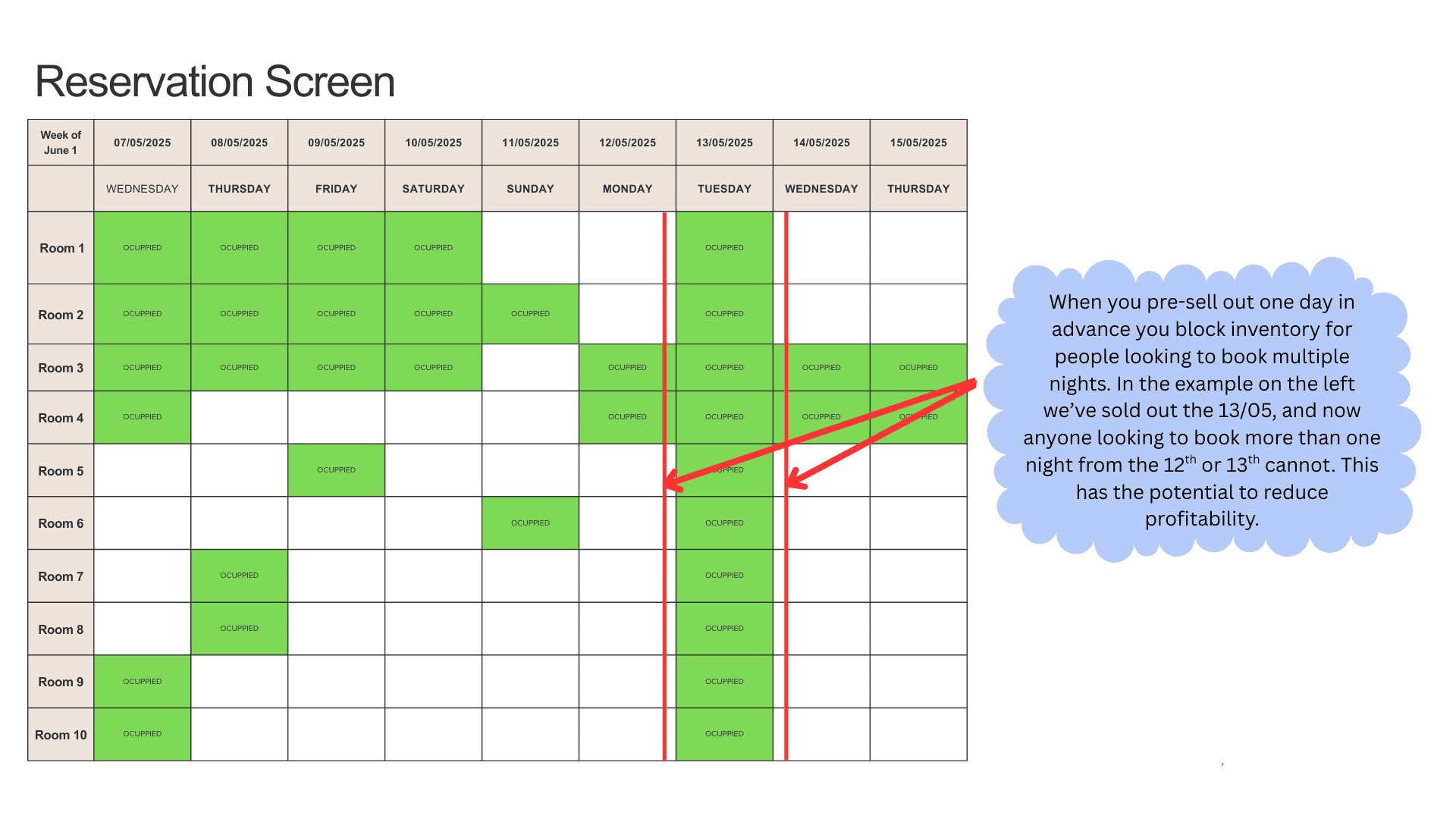
When you hit 100% occupancy for a date months in advance, you’ve effectively killed your property’s ability to take any multi-night bookings that overlap that date.
The Logic: Long-stay guests book early. Single-night "road warriors" book late.
The Error: If you sell your last room to a single-night guest 60 days out, you just rejected every 3-night or 5-night inquiry that would have covered your quiet "shoulder" days.
The Fix: Use your booking windows to spot these "peaks." If you see a spike, stop selling and implement a strategy. Raise the rate or shut off one-night stays immediately.
Critical: You must actively monitor these dates. If a major event is cancelled or moves, you must be fast enough to release those restrictions (like Minimum Length of Stay) before the market moves past you.
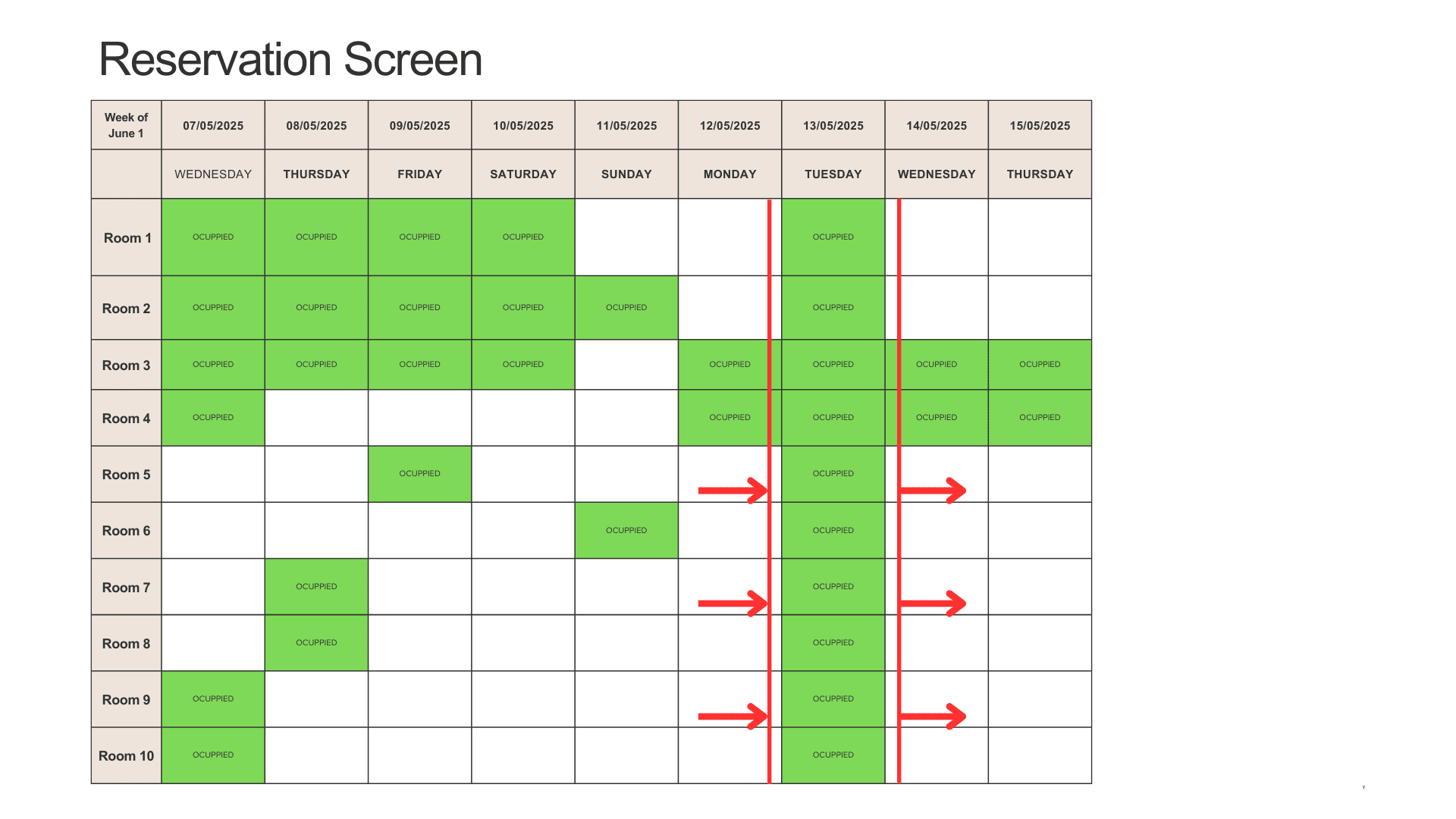
Above illustrates the damage a sold out date can cause surrounding occupancy. To leverage these strategies it is important to learn your motels booking window.
Booking Window
Booking Window shows when bookings come through. It will be different for different times of the year, holiday periods, day of the week and room type.
Analysis Paralysis is where you track so many things that you can’t make a decision. Develop your strategy in stages - it is about building an understanding of how your motel gets booked so that you can better manage your room inventory and room rates.
Stage 1: Track your booking window for all room types based on the month.
Stage 2: Track your booking window for all room types based on the month - but split your tracking into two baskets: Double and Twin Rooms in one basket and Family (or larger multi-person) rooms in another basket.
Stage 3: Above, but now overlay your school holiday periods. You might notice in these periods the types of rooms that get booked changes. If your in a holiday spot - your family rooms might start getting filled up.
This is a good basic setup you can work with. In our book: The Essential Guide to Motel Management we go into far more depth to make it easy to understand. This book is packed with 100s of templates and real tools to help you run your motel.
Missing small rate increases and rate restrictions can quickly equate to over $100,000 in revenue leaks in a 20+ room motel. If your current strategy is leaking revenue - reach out and setup a phone call. Our Motel Consultancy Service will stop you losing revenue - we can either work with your on-site management team in a oversight role or provide motel training.
Important Questions to ask about Booking Window
How far is the sell out date? Multiple night bookings as a % will be booked further in advance than single night bookings. The further out the hotel is becoming sold out the more potential there is for lost multi-night bookings.
Important: If you are pre-selling out or carry a lot of bookings for future dates then this will often be a signal to do a rate review.
Dates that are in high demand need to be leveraged to increase occupancy on the dates either side - these are called the shoulder dates.
High Demand Dates
High-demand dates (festivals, sports, regional shows) are your leverage. If you know the whole town is going to sell out, you hold the cards. Use a Minimum Length of Stay (MLOS) restriction to force the market to fill your quiet nights.
As the Motel Manager it is important to continually review and optimise your strategy.
Assess the Town: Is the whole zip code booked? If yes, don't just "experiment" with one room type. Slap a 2 or 3-night minimum across the board.
Tier Your Restrictions: If demand is steady but not "crazy," put a 3-night minimum on your cheap standard rooms and a 2-night minimum on your executive suites. Make the "one-nighters" pay for the premium space if they want to break your calendar.
The Shoulder Strategy: Your goal is to make Saturday’s demand pay for Friday and Sunday’s vacancy.
Setting a Length of Stay Restriction
Strategy Checklist (Template)
Rate Review: If you are over 60% booked for a date more than 3 months away, your rate is too low. Raise it. * Check the Source: If a spike is caused by a single group booking, ask: "Is the town historically busy now, or is it just this group?" If the town is quiet, take the group. If the town is busy, the group is standing in the way of higher-paying individual guests.
Watch the Windows: If you haven't captured your long-stay guests by the 21-day mark, you’ve lost them to the competitor who planned better.
No Hesitation: In revenue management, being "nice" to a one-night traveler costs you hundreds in lost occupancy on the days surrounding their stay.
